Oral Health · Everyday Care
Your Mouth Is More Complex Than You Think.
We brush. We rinse. We try to take care of our smiles.
But there may be more to everyday oral care than simply keeping your teeth clean.

Oral Health · Everyday Care
We brush. We rinse. We try to take care of our smiles.
But there may be more to everyday oral care than simply keeping your teeth clean.
The Story
I brushed every morning. I brushed again before bed. I tried to remember to floss. I kept up with regular dental care.
So why did I still feel like there was more I could understand about my own oral health?
It wasn’t worry, exactly. It was curiosity. The kind that starts quietly, in front of a bathroom mirror, on an ordinary Tuesday morning.


Common Assumptions
Brush. Rinse. Floss. Visit the dentist.
Done.
That’s the version most of us grew up with, and it genuinely matters. Cleaning is important.
But the more I learned, the more I realised there was another side to the story.
The Discovery
The mouth isn’t only a surface. It’s an environment — a warm, moving, constantly changing one, home to a large community of microorganisms.
Oral health, it turns out, involves more than the visible surface of teeth. Everyday habits — what we eat and drink, how consistent our routine is, how much water we drink — all influence that environment.
Researchers continue to study this area, and there is still a great deal being learned. Individual experiences vary.
But the framing alone was new to me: an environment to support, rather than a surface to scrub. That single shift has changed how many people think about everyday oral care.

The Micro-World
Scientists call it the oral microbiome: a diverse community of microorganisms living on teeth, along the gumline, on the tongue and across soft tissue. Many of them are simply part of a normal, healthy mouth.
What draws growing scientific interest isn’t any single species — it’s the relationship between them. A complex ecosystem, quietly at work, every single day.
Everyday Practice
Brushing
Twice a day, gently and thoroughly.
Flossing
The spaces a brush simply can't reach.
Hydration
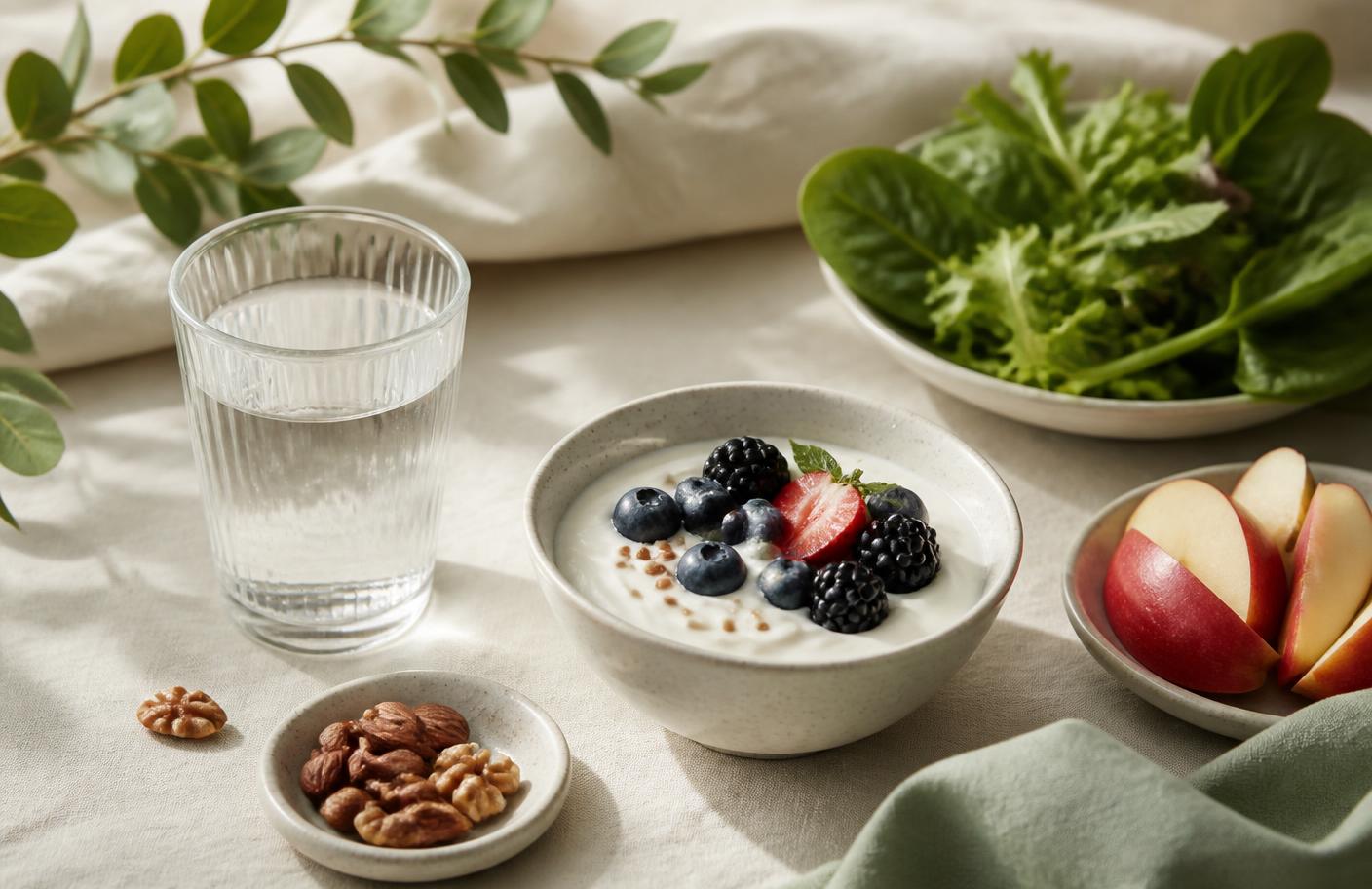
Water throughout the day supports a moist mouth.
Food choices
Frequent sugar means a more frequent challenge.
Nighttime routine
The longest stretch your mouth goes unattended.
Regular check-ups
A professional set of eyes, on schedule.
None of it is complicated. It’s a routine, not a project — and consistency tends to matter more than intensity.
Continue to the full presentation.

Evening
Evenings are easy to rush. It’s late, the day is finished, and the last few minutes in the bathroom often get the least attention.
Yet those minutes begin the longest stretch of the day — hours in which the mouth is left to itself. For many people, the evening routine became the part worth slowing down for.
Not because something is wrong. Because habits are simply easier to keep when they’re part of a rhythm.
What else should we be thinking about?

A Different Way to Think About It
Maybe it’s about understanding what you’re already doing — and why it matters.
Modern oral-health thinking increasingly looks at the mouth as a complete environment, rather than focusing only on the visible surface of teeth.
It’s a balanced, unhurried idea — and one researchers continue to explore. It doesn’t replace anything you already do. It simply gives the routine a reason.
The Next Step
I wasn’t looking for a complicated routine.
I simply wanted to understand this approach better — and see what the full explanation was really about.
Continue to the full presentation.
Sometimes the biggest changes in the way we think about our health begin with a simple question.
What if there was more to everyday oral care than we had been taught to consider?

The Full Explanation
It takes a few minutes, and it explains this way of thinking about everyday oral care far better than a single article can.
Continue to the official presentation.